

How agentic AI shifts the primary source of competitive advantage from applications toward process intelligence.
A Strange Paradox Is Emerging
For decades, enterprise software vendors built their dominance on a simple reality: once a business standardized on a platform, changing it was extraordinarily difficult.
ERP systems. CRM systems. HR platforms. Claims systems. Core banking platforms.
The software itself became the moat.
Data migration projects took years. Integrations required armies of consultants. Business processes became tightly coupled to the applications that executed them.
Organizations often stayed with software not because it was the best choice, but because leaving was simply too expensive.
That world is beginning to change.
Agentic AI is dramatically reducing the effort required to understand data models, generate integrations, map schemas, build APIs, create workflows, migrate data, and reconfigure business processes. As these capabilities mature, switching costs begin to collapse.
But something unexpected happens. The reduction of software lock-in does not simplify the enterprise. It creates an entirely new challenge.
The Real Challenge of Agentic AI Isn’t Intelligence. It’s Coordination.
Most discussions about enterprise AI focus on intelligence. How smart are the models? How autonomous are the agents? How many tasks can AI perform?
These are important questions. But they miss the larger transformation underway.
The future enterprise will not contain fewer applications – it will contain more. It will not contain fewer systems – it will contain more. And it will not contain fewer workers – it will contain both human and digital workers operating simultaneously.
A typical enterprise may soon operate hundreds of SaaS applications, multiple systems of record, thousands of AI agents, internal and external services, specialized AI models, human teams, and automated workflows – all at once.
According to Gartner, 40% of enterprise applications will feature task-specific AI agents by 2026, up from less than 5% in 2025 [1]. A recent industry analysis further indicates that 79% of organizations report some level of AI agent adoption, with 96% planning to expand usage in 2026 [2].
The challenge is no longer intelligence. The challenge is coordinating intelligence.
The Shift Nobody Is Talking About
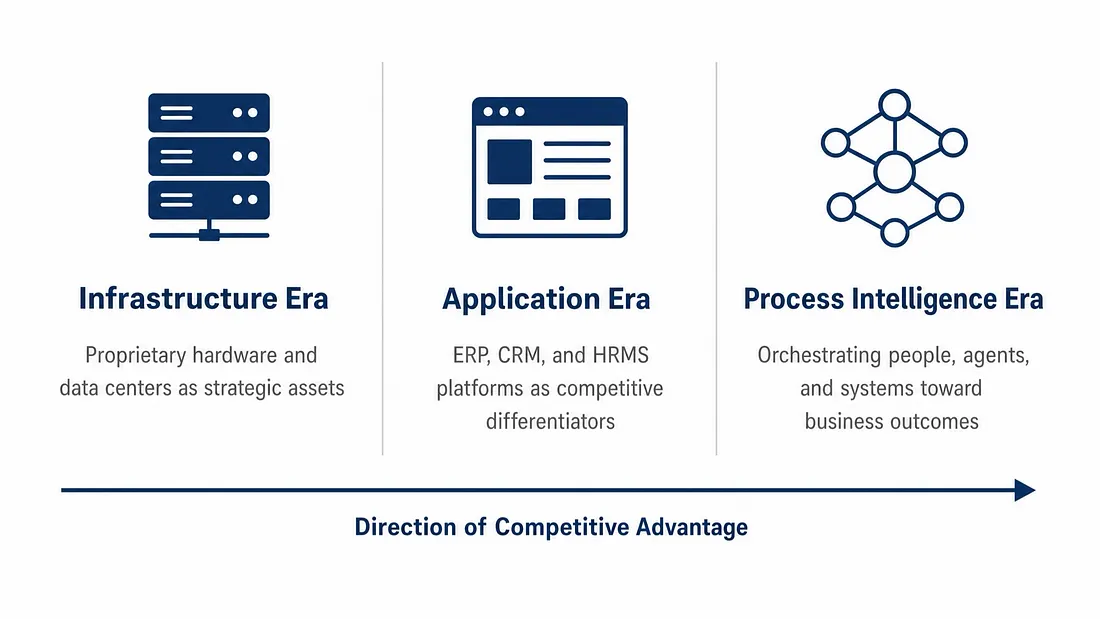
Historically, competitive advantage came from three sources.
Infrastructure Advantage: Organizations invested in proprietary infrastructure – servers, networks, datacenters. Over time, infrastructure became a commodity as cloud providers abstracted complexity away.
Application Advantage: Organizations then invested heavily in enterprise applications: ERP, CRM, HRMS, and industry-specific platforms. The software itself became a strategic asset. The assumption was simple: better software creates better outcomes.
Process Intelligence Advantage: Agentic AI changes the equation. As applications become easier to integrate, customize, and replace, competitive advantage begins shifting elsewhere – toward process design, process orchestration, process governance, process optimization, institutional knowledge, and organizational adaptability.
The question is no longer: “What software do we use?”
The question becomes: “How quickly can we redesign and execute our business processes regardless of what software we use?”
That is a fundamentally different source of competitive advantage.
Applications Are Becoming Infrastructure
This does not mean applications disappear. Far from it.
ERP systems still provide transaction integrity. CRM platforms still manage customer relationships. Financial systems still provide controls and compliance. Systems of record remain essential.
But their role changes. They increasingly become execution endpoints rather than centers of intelligence
Just as databases became infrastructure. Just as cloud became infrastructure.
Applications become infrastructure.
The strategic layer moves higher.
The Missing Layer in Enterprise Architecture
Most enterprises today have systems of record, data platforms, AI models, AI agents, APIs, and SaaS applications. Yet something is missing.
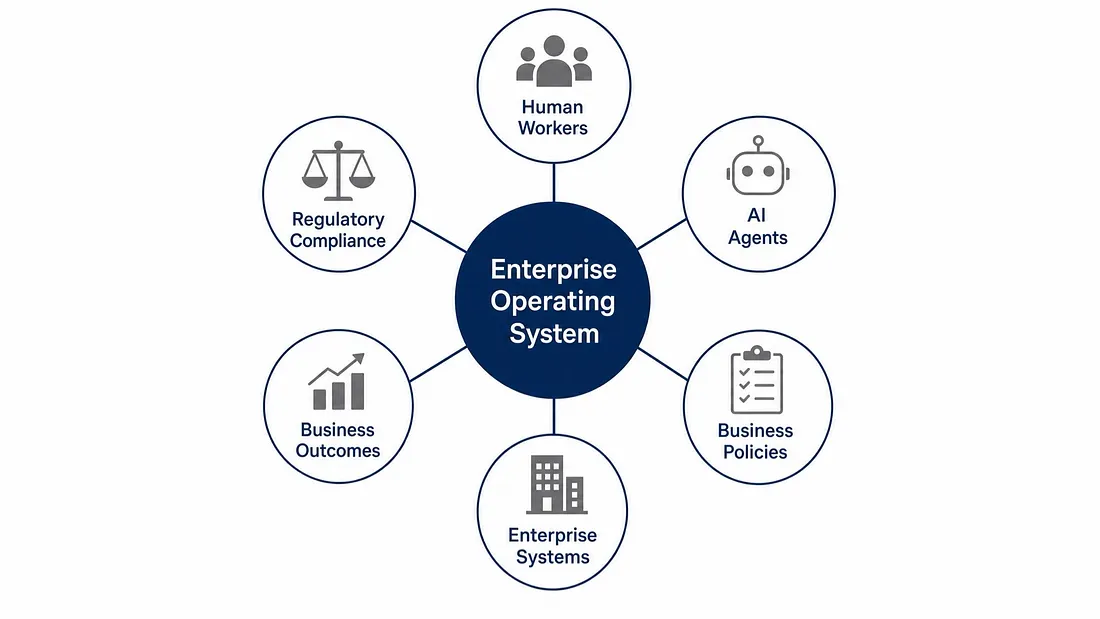
There is no operating layer responsible for coordinating business intent, enterprise policies, human workers, digital workers, AI agents, enterprise systems, and business outcomes into a single coherent whole.
This creates fragmentation. AI pilots succeed locally but fail to scale globally. Departments optimize independently while enterprise complexity increases. The enterprise gains intelligence but loses coherence.
Introducing PIE: The Enterprise AI Operating System
PIE – the Process Intelligence Engine – was built around a simple but powerful observation: businesses do not operate through applications. Businesses operate through processes. Applications are merely implementation details.
Rather than embedding business logic inside individual systems, PIE establishes an enterprise-wide operating layer that treats business processes as first-class assets. Processes become executable, governable, observable, and continuously optimizable – independent of the underlying applications that carry them out.
The result is an enterprise that can adapt its operations in response to change – whether that change is a new regulation, an acquisition, or a platform migration – without requiring wholesale rewrites of operational logic.
Consider what this means in practice. When a large organization faces a regulatory change that touches its customer onboarding process, the traditional path involves months of coordinated updates across multiple systems and teams. In a process-intelligent enterprise, the adaptation is managed at the operating layer, allowing the organization to respond at the speed of business rather than the speed of IT.
Agility, in this model, becomes an architectural capability rather than an organizational aspiration.
A Multi-Layered Architecture for the Modern Enterprise
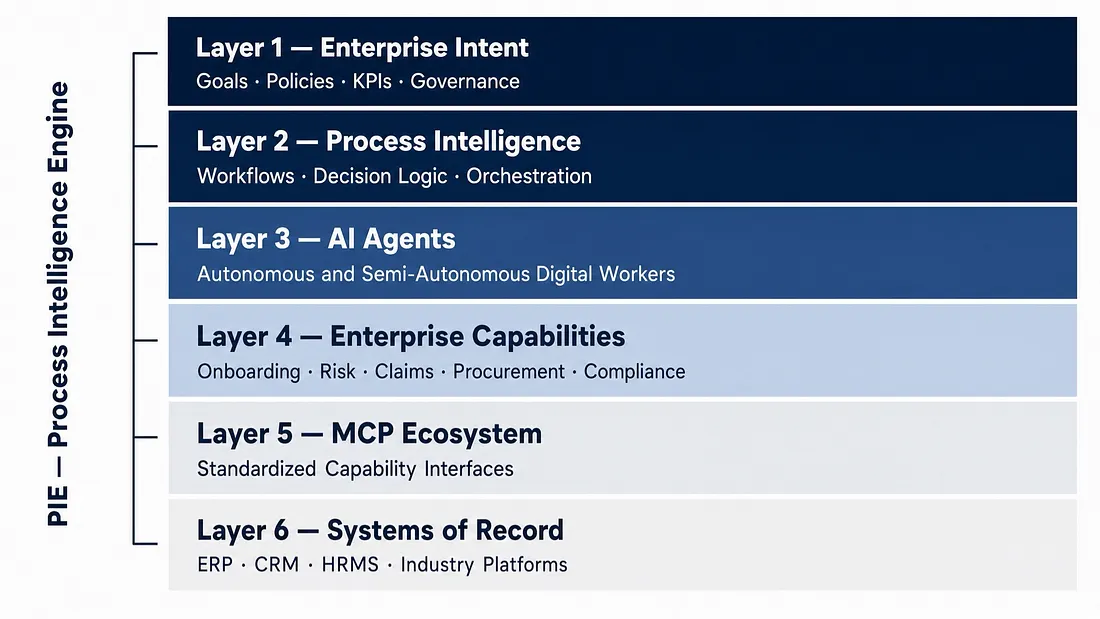
PIE is designed as a structured hierarchy that separates business intent from technical execution. At the highest level sits enterprise intent – the goals, policies, KPIs, and governance requirements that define what the business is trying to achieve. Beneath that lies the process intelligence layer, where business workflows, decision logic, and orchestration patterns are defined and managed.
Below the process layer, AI agents serve as the digital workforce responsible for execution. These agents draw on a set of reusable enterprise capabilities – common business services that can be composed and recomposed as needed. Standardized interfaces connect these capabilities to both internal and external services. And at the foundation, systems of record – ERP, CRM, HRMS, and industry platforms – serve as execution endpoints, receiving instructions rather than issuing them.
The key architectural principle is separation: intelligence and intent live at the top; execution happens at the bottom. This separation is what makes the enterprise adaptable.
Why This Matters
Imagine an enterprise that acquires another company, replaces a CRM platform, migrates its ERP, adopts a new AI infrastructure, implements new regulations, and launches new products – all within the same fiscal year.
Today, each of these changes triggers months of redesign. Data migration alone consumes 15 – 25% of an average ERP implementation budget [3]. The operational logic embedded inside each application must be painstakingly extracted, translated, and re-implemented.
In a process-intelligent enterprise, these changes are absorbed at the operating layer. The underlying systems may change; the business processes do not need to be rebuilt from scratch. The enterprise evolves without losing continuity.
Governance Becomes the New Differentiator
As organizations deploy AI agents at scale, governance becomes non-negotiable. Gartner warns that over 40% of agentic AI projects will be canceled by the end of 2027 due to unclear business value or inadequate risk controls [4]. The failure mode is not a lack of capability – it is a lack of control.
Enterprises need auditability, traceability, explainability, policy enforcement, human oversight, and regulatory compliance. Without governance, agentic AI creates risk. With governance, agentic AI creates scale.
An enterprise operating system must be designed to provide both. Governance is not a constraint on intelligence – it is the condition that makes intelligence trustworthy enough to deploy at enterprise scale.
The Future Enterprise
The future enterprise will not be defined by its ERP. It will not be defined by its CRM. It will not be defined by its AI models.
It will be defined by how effectively it transforms intent into outcomes.
The winners will be organizations that can continuously design, orchestrate, govern, and optimize business processes faster than their competitors. In that future, applications remain important – but they are no longer the primary source of competitive advantage.
Process intelligence becomes the differentiator. And the enterprise operating system becomes the platform that makes it possible.
Final Thought
The biggest misconception in enterprise AI is that agents are the destination. They are not.
Agents are workers. Applications are tools. Data is fuel.
The real challenge is coordinating all of them into a coherent enterprise – one where every agent, every system, and every human worker operates in service of a shared set of business processes and outcomes.
The future belongs not to the organization with the most agents. It belongs to the organization with the best operating system for intelligence
References
[1] Gartner. Gartner Predicts 40% of Enterprise Apps Will Feature Task-Specific AI Agents by 2026, Up from Less Than 5% in 2025. August 26, 2025.
[2] Landbase. 39 Agentic AI Statistics Every GTM Leader Should Know in 2026. January 5, 2026.
[3] KPMG. ERP Data Migration. Compact Magazine.
[4] Gartner. Gartner Predicts Over 40% of Agentic AI Projects Will Be Canceled by End of 2027. June 25, 2025.