
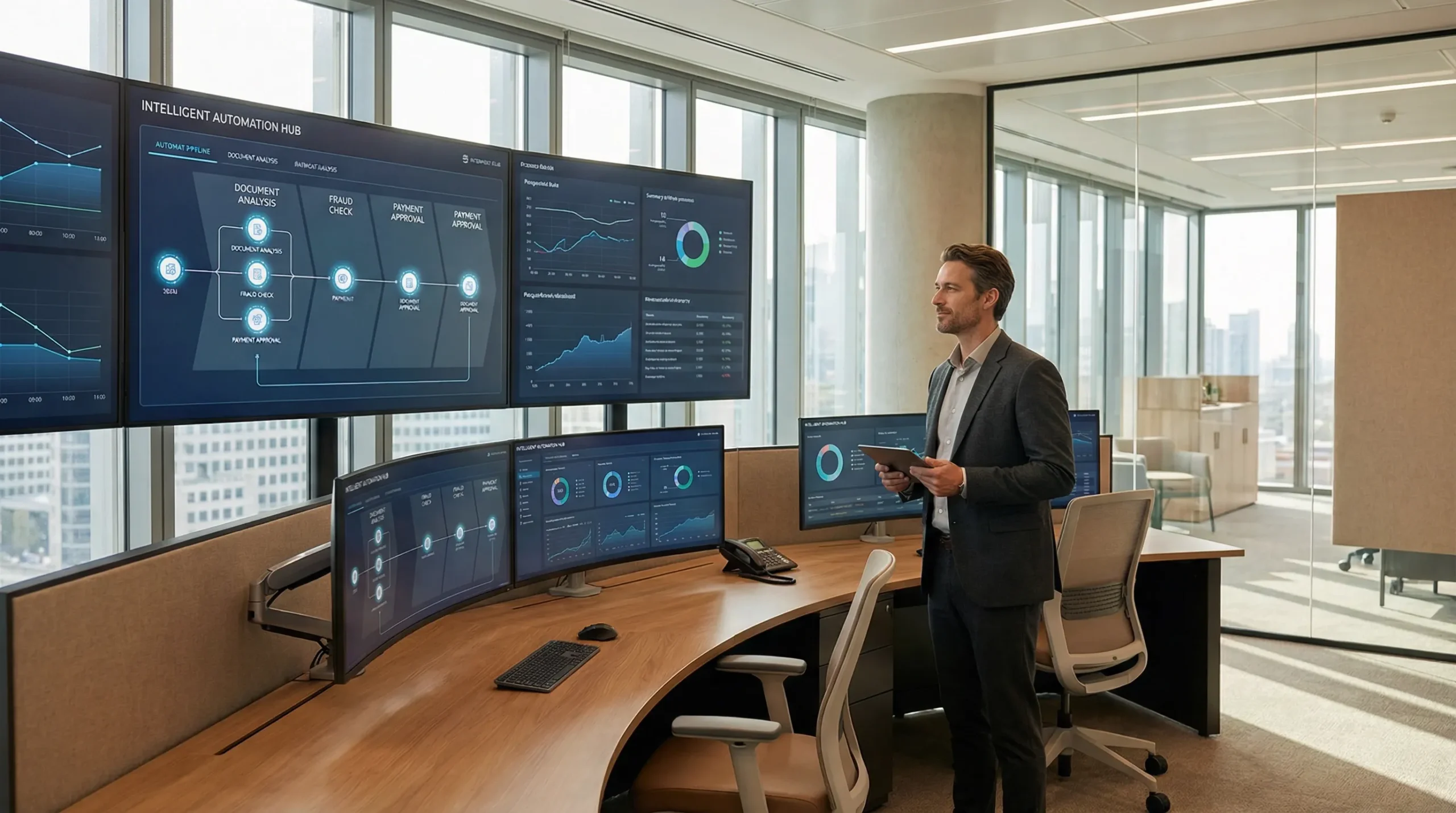
Why the enterprise of the future will not be run by applications — but by PIEs.
The enterprise of the future will not be run by applications. It will be run by Process Intelligence Engines.
The Agentic AI Moment
For the past year, most enterprise AI conversations have focused on copilots. Copilots for developers. Copilots for sales teams. Copilots for analysts. These tools help people work faster. But they do not fundamentally change how enterprises operate.
The real transformation driven by Agentic AI is considerably larger. Agentic systems can now plan multi-step workflows, reason about goals and outcomes, interact with enterprise systems, collaborate with other agents, and escalate decisions to humans when needed.
In other words, AI is evolving from assistive intelligence to operational intelligence. And once AI can orchestrate workflows, something remarkable becomes possible: business processes themselves can become intelligent systems.
This leads to a new architectural abstraction for enterprises: the Process Intelligence Engine (PIE).
The Problem With Application-Centric Enterprises
For decades, enterprise technology has been organized around applications. Typical stacks include ERP, CRM, MES, PLM, document systems, and data platforms. These applications are excellent at recording transactions and storing data. But they do not actually run business processes end-to-end.
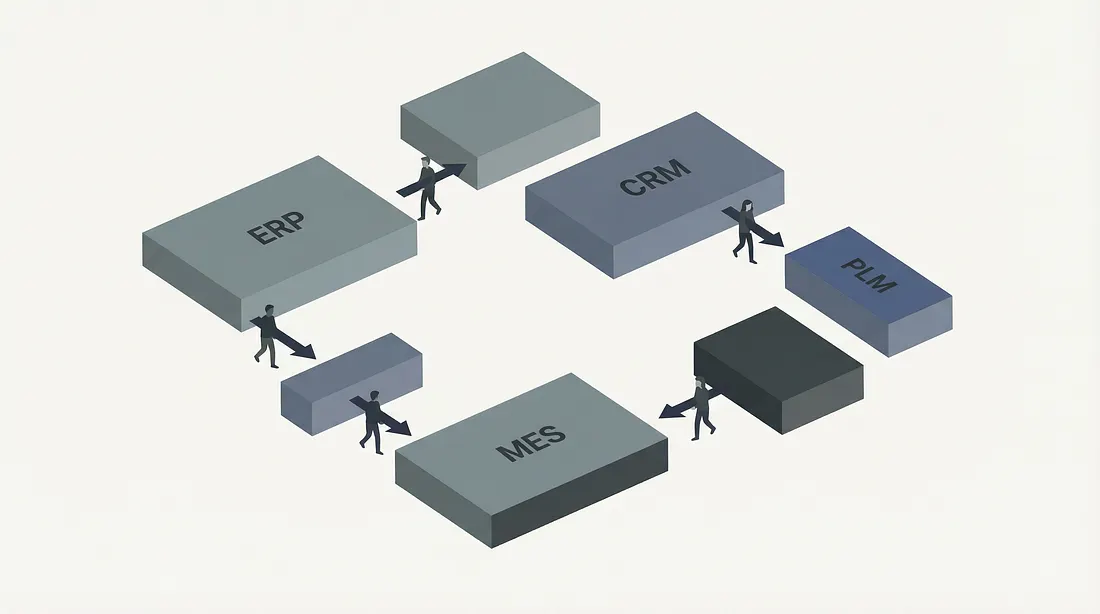
Consider a common enterprise workflow like insurance claims processing. A claim is submitted through a customer portal, documents are uploaded and verified, policy details are validated, fraud checks are performed, damage is assessed, and payment is approved and issued. Each step typically happens in a different system. Humans coordinate across these systems.
Despite decades of digitization, most enterprise processes remain fragmented, human-orchestrated, and slow to adapt. Which leads to a simple but important observation:
Applications store the enterprise. Processes run the enterprise. Yet enterprise architecture has always been designed around applications, not processes.
Agentic AI Changes the Equation
Agentic AI introduces a fundamentally new capability into enterprise systems. AI agents can now understand goals, break work into tasks, access enterprise tools, collaborate with other agents, and dynamically adapt workflows. This enables something enterprises have never had before: intelligent process orchestration.
Instead of humans coordinating systems, agents can coordinate processes. This shift requires a new architectural building block.
Introducing the Process Intelligence Engine
A Process Intelligence Engine (PIE) is an intelligent system responsible for the end-to-end execution of a business process. It combines several capabilities into a single coherent unit.
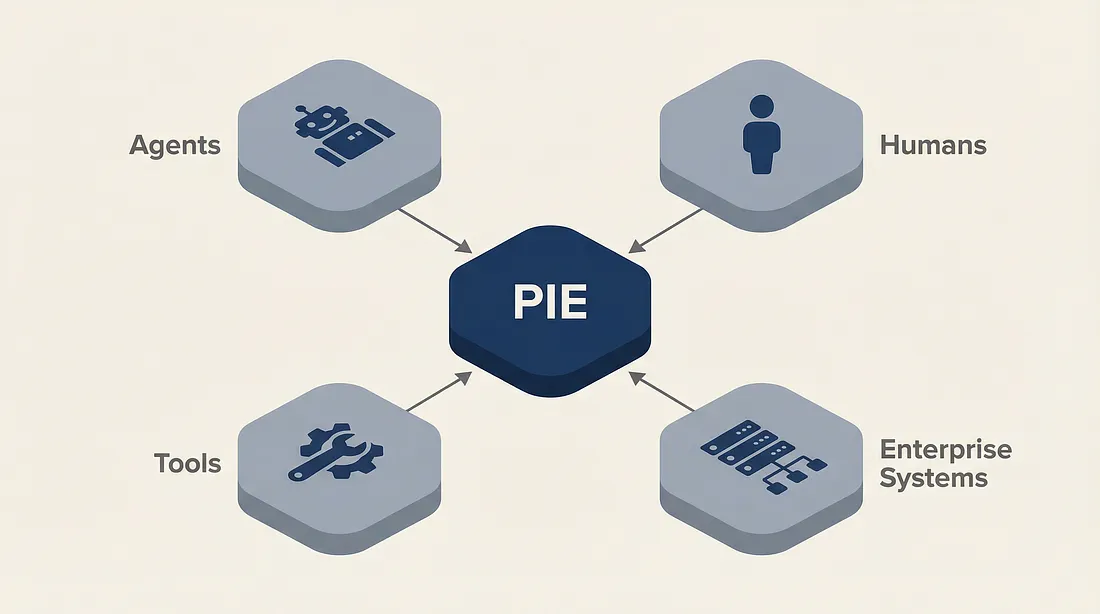
PIE = Agents + Humans + Tools + Enterprise Systems
Each PIE owns the end-to-end execution of a specific business process. Examples include a Claims Processing PIE, a Loan Approval PIE, a Procurement PIE, and an Accounts Payable PIE. Instead of humans stitching systems together, the PIE orchestrates the process.
The key components of a PIE work in concert:
- Agentic AI — agents reason about the process and execute tasks autonomously
- Human-in-the-loop governance — humans review decisions when risk or policy requires oversight
- Enterprise tool access — agents interact with enterprise capabilities through governed interfaces
- Agent-to-agent collaboration — multiple agents coordinate across process steps
- Deterministic enterprise systems — ERP, CRM, and databases remain the system of record
Reimagining the Enterprise
Once we adopt Process Intelligence Engines, enterprise architecture becomes considerably clearer. An enterprise consists of departments. Departments run business processes. Each process is powered by a Process Intelligence Engine.
For example, in an insurance company, the Claims Department might operate a Claims Intake PIE, a Claims Validation PIE, and a Claims Settlement PIE. The Underwriting Department might run a Risk Assessment PIE and a Policy Issuance PIE. Each process becomes an intelligent execution engine rather than a sequence of manual handoffs.
The Six-Layer PIE Architecture
To implement PIEs at enterprise scale, a layered architecture is required. Each layer serves a distinct function, and a critical principle governs how agents interact with the layers below them.
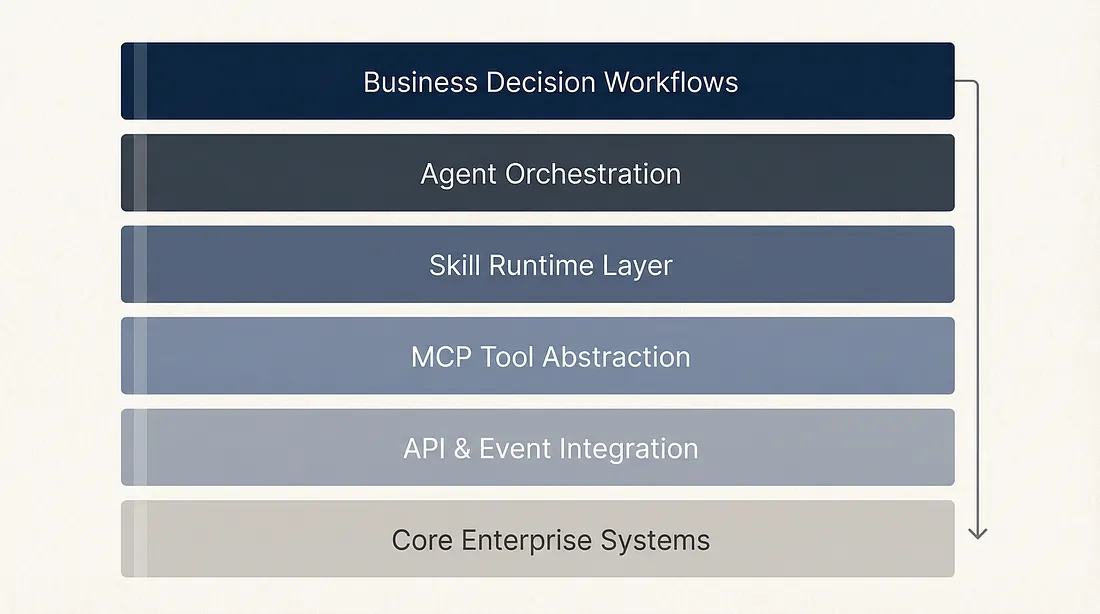
Agents interact with governed tools — not directly with enterprise APIs. This ensures security, governance, auditability, and enterprise control at every layer of the stack.
The architecture flows from business intent at the top, through agent orchestration and skill execution, down to the governed tool interfaces and integration layer, and ultimately to the core enterprise systems that remain the authoritative system of record.
Example: Insurance Claims Processing as a PIE
The Traditional Workflow
In a conventional claims operation, the process moves linearly through disconnected systems: customer portal → claims system → document verification → fraud system → adjuster review → payment system. Humans coordinate each handoff. The result is delays, inconsistency, and limited adaptability.
The Agentic Approach
In an agentic enterprise, the entire workflow becomes a Claims Processing PIE. The process is executed by a coordinated sequence of specialized agents, with a human adjuster retained at the critical decision point.
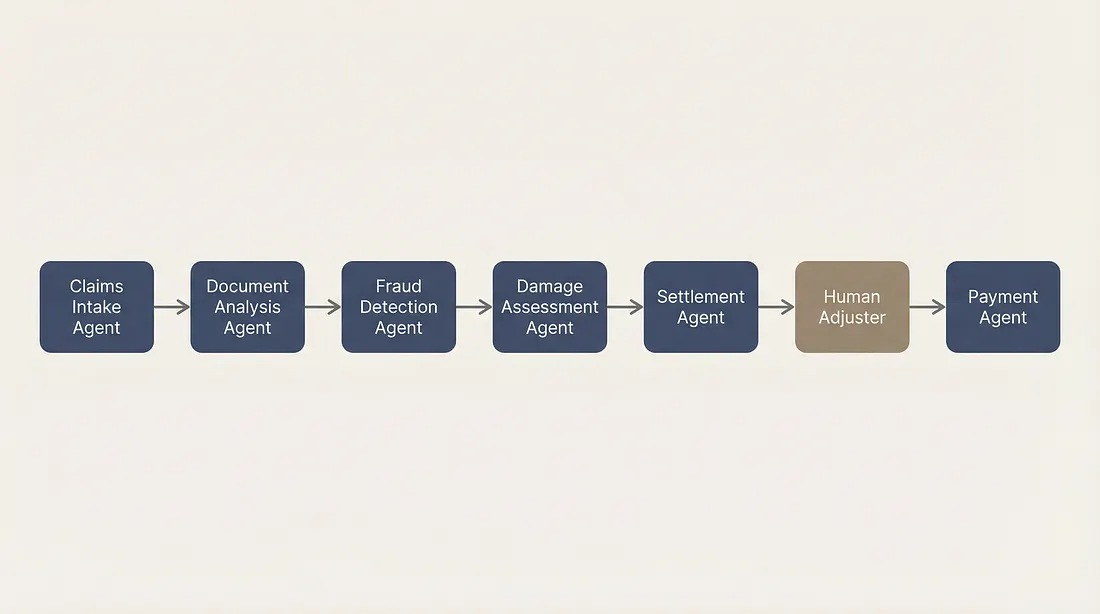
- Claims Intake Agent: Receives the claim submission, validates claim information, and retrieves relevant policy data.
- Document Analysis Agent: Extracts information from uploaded documents and verifies supporting evidence.
- Fraud Detection Agent: Evaluates claim risk and calls fraud scoring models to flag anomalies.
- Damage Assessment Agent: Estimates damages using historical claims data and comparable settlements.
- Settlement Agent: Calculates the payout and prepares a settlement recommendation.
- Human Claims Adjuster: Reviews high-risk claims and approves the settlement — the essential human governance checkpoint.
- Payment Execution Agent: Triggers payment through financial systems upon adjuster approval.
Instead of humans coordinating systems, agents coordinate the process. The human adjuster is not removed — they are repositioned at the point where their judgment adds the most value.
The Agentic Enterprise
When multiple PIEs operate across departments, something powerful emerges. PIEs begin collaborating with each other, passing context and outcomes across process boundaries. The enterprise becomes a network of intelligent process engines.
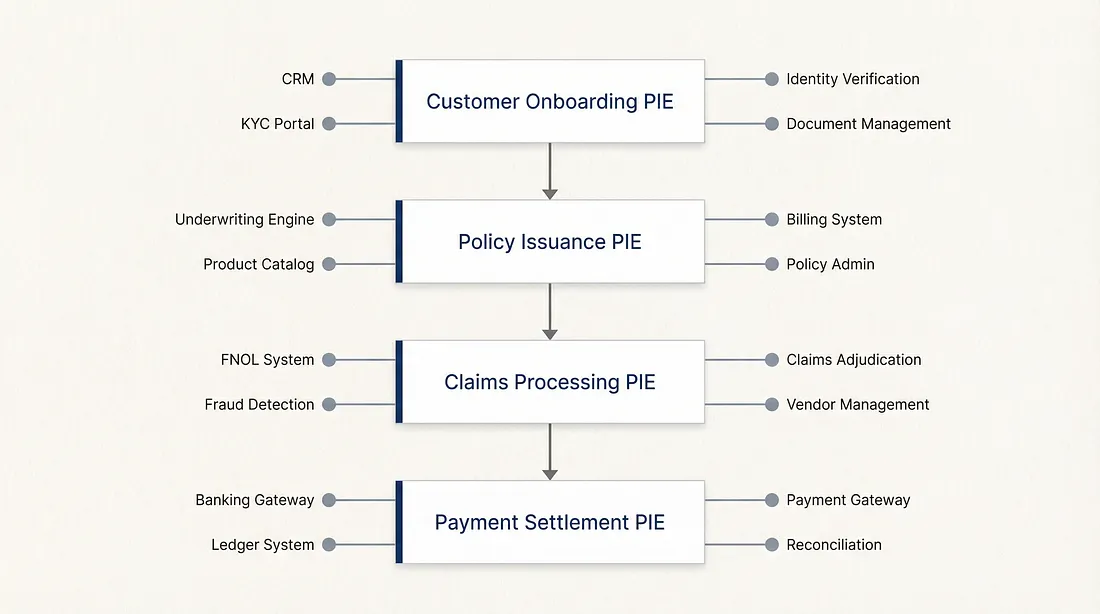
In an insurance context, a customer onboarding event triggers the Policy Issuance PIE, which in turn feeds the Claims Processing PIE, which connects to the Payment Settlement PIE. The enterprise operates as a coherent, adaptive system rather than a collection of isolated applications.
This is what we call the Agentic Enterprise.
Why This Matters
Most AI initiatives today focus on individual productivity. Copilots make employees faster. But the real opportunity lies in process intelligence. When processes become intelligent, decision cycles accelerate, operational costs decline, coordination improves, and enterprises become adaptive systems capable of responding to change in real time.
The distinction is important. Productivity tools improve the performance of individuals within a fixed process architecture. Process intelligence transforms the architecture itself.
The Enterprise Operating Model of the Future
Over the past three decades, enterprise transformation focused on digitizing systems. SAP, Salesforce, ServiceNow — the great enterprise software platforms of the past generation were built to record and manage business activity. They succeeded enormously at that mission.
The next transformation will focus on intelligent processes. The organizations that win in the age of Agentic AI will not simply deploy better tools. They will redesign their architecture around Process Intelligence Engines — treating each business process as a first-class intelligent system, not an afterthought stitched together from application outputs.
The enterprise of the future will not be run by applications. It will be run by Process Intelligence Engines.
The architectural shift is underway. The question for enterprise leaders is not whether PIEs will emerge — it is whether their organizations will design for them deliberately, or discover them by accident.